

A low AMH result on a fertility test can feel like a door slamming shut. That feeling only grows after searching online and finding countless promises of quick fixes.
Before anything else, here is the truth about how to increase AMH hormone levels. Current medical evidence does not support any method that reliably or significantly raises AMH once it has declined.
The guide explains why. It also covers what actually helps protect your ovarian health and what a low result really means for your fertility.
What Is the AMH Hormone?
Anti-Müllerian Hormone (AMH) signals a protein output from the follicles within the ovary. It can be used to evaluate a female’s ovarian reserve. Its levels are indicative of the number of eggs—more eggs if higher and fewer reserves if lower. The use of AMH test results is normally adopted in case of fertility workup but is not a direct predictor of the chance of conception.
Understanding How To Increase AMH Levels Honestly
Anti-mullerian hormone reflects your remaining egg supply. It is not a hormone deficiency that responds to correction the way something like low vitamin D might.
When people search for how to increase AMH hormone levels, the honest medical answer is simple. AMH cannot be meaningfully or permanently raised through diet, supplements, or lifestyle changes alone.
AMH is produced by small follicles in your ovaries. Because of this, a low number reflects a smaller remaining follicle pool, not a treatable imbalance. This distinction matters enormously.
Reputable fertility specialists confirm this consistently. No supplement or protocol has been proven to reliably increase true ovarian reserve in controlled studies.
However, this does not mean a low AMH result is hopeless. Many women with low AMH still conceive naturally or through fertility treatment.
AMH measures quantity, not the quality of your remaining eggs, and pregnancy only requires one healthy egg released at the right time.
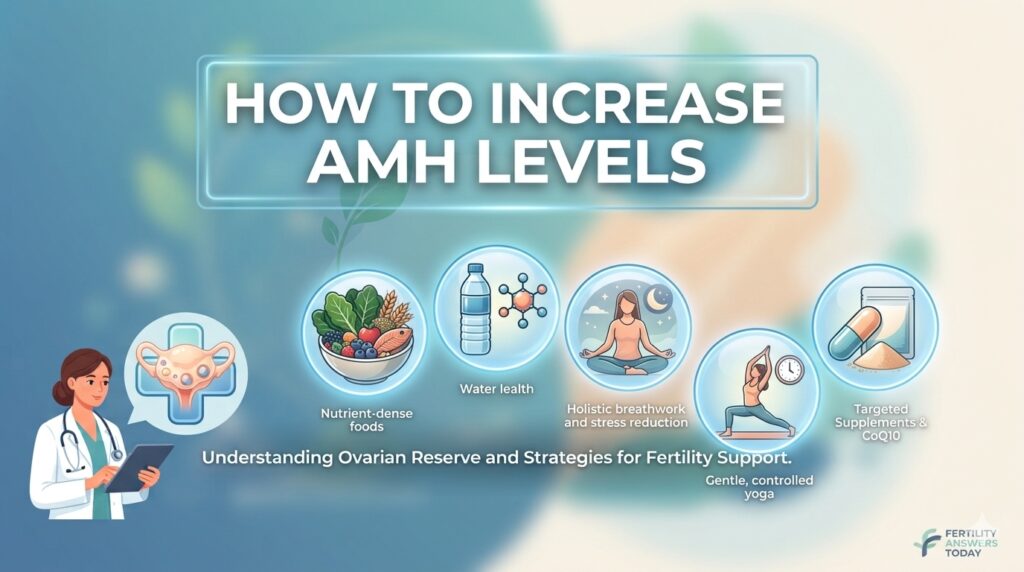
What a Low AMH Result Actually Tells You?
Context matters enormously when interpreting your specific number. A normal AMH range typically falls between 1.0 and 4.0 nanograms per milliliter.
Labs vary slightly in their reference ranges, though. Anything below roughly 1.0 gets classified as low, while levels under 0.16 are considered undetectably low.
Age plays the single biggest role in this picture. AMH naturally declines as women get older. This reflects the normal reduction in follicle count that happens across every woman’s reproductive lifespan.
So, a low result at age 42 carries different implications than the same number at age 28. The underlying cause and available options differ considerably.
Additionally, AMH tells you about quantity, not quality. It says nothing about your fallopian tubes, uterine health, or your partner’s fertility factors.
Because of this, a low AMH result works best as one piece of a larger fertility evaluation. It is not a standalone verdict on your reproductive future.
What Can Actually Support Your Ovarian Health?
Dramatically improving your how to improve AMH level results is not realistic. Still, certain habits genuinely support the eggs you do have and may slow further decline.
Quitting smoking stands out as one of the clearest, most evidence-backed steps available. Smoking is directly linked to lower AMH and faster ovarian aging.
Maintaining a healthy weight matters too. Both very high and very low body weight can negatively affect reproductive hormones. Because of this, working toward a stable, healthy range supports your overall fertility picture.
Additionally, moderate exercise supports reproductive health, though excessive intense training can sometimes work against you instead.
Correcting a genuine vitamin D deficiency may offer modest support for reproductive health. This applies to women who are actually deficient, confirmed through bloodwork rather than assumption.
Antioxidants like CoQ10 show some evidence for supporting egg quality specifically. Omega three fatty acids from foods like salmon and walnuts help too, though their effect on the AMH number itself remains limited and inconsistent across studies.
Curious whether your current habits are actually supporting your fertility or working against it. A real conversation with a provider who understands your full health picture answers that question. It works far better than another online article.
How To Maintain AMH Level and Protect What You Have?
How to maintain AMH level is a more realistic goal than dramatically increasing it. Hence, protecting your existing ovarian reserve deserves real attention. Avoiding unnecessary exposure to endocrine-disrupting chemicals may help too.
Evidently, these chemicals are heavily infused in personal care, beauty products, and plastic utensils. When you reduce these products from daily life, it consequently reduces stress on the reproductive system.
Moreover, chronic stress is the culprit here too. The effects of prolonged stress accumulate and show up on the body.
While stress reduction practices support your broader hormonal health, the direct effect on AMH specifically remains unclear.
At Hamilton Wellness, our approach to hormone balance for men and women looks at your complete hormonal picture.
We believe in not focusing on one element only. It is a holistic approach. Fertility and hormone health involve multiple interconnected systems working together.
Dr. Samra Latif at Hamilton Wellness takes a functional medicine approach to evaluating hormone health. She helps patients understand their full picture rather than chasing a single test result.
How Are AMH Levels Measured?
AMH levels are measured through a simple blood test that assesses ovarian reserve by evaluating the concentration of anti-Müllerian hormone in the bloodstream. This test can be conducted at any time during the menstrual cycle, as AMH levels remain relatively stable. Below is a general classification of AMH levels:
| AMH Level (ng/mL) | Interpretation |
| Above 3.0 | High (Possible PCOS) |
| 1.0 – 3.0 | Normal (healthy ovarian reserve) |
| Below 1.0 | Low (diminished ovarian reserve) |
What Are Good AMH Hormone Levels For Your Age?
A good AMH hormone level varies by age, with higher levels in younger women indicating a better ovarian reserve. Below is a general guideline for AMH hormone levels by age:
| Age | AMH Level (ng/mL) |
| 25 | 3.0 and above |
| 30 | 2.5 and above |
| 35 | 1.5 |
| 40 | 1.0 |
| 45 | 0.5 |
Which food increases AMH level?
While no specific food can directly increase AMH hormone levels, a nutrient-rich diet can support ovarian health and overall fertility. Here are some beneficial foods:
| Food | Benefit | Potential Impact on AMH |
| Fatty Fish (Salmon, Mackerel) | Rich in Omega-3, supports hormone balance | May help maintain ovarian function |
| Leafy Greens (Spinach, Kale) | High in folate and antioxidants | Supports egg quality |
| Berries (Blueberries, Strawberries) | Packed with antioxidants | Protects eggs from oxidative stress |
| Nuts & Seeds (Walnuts, Flaxseeds) | Provide vitamin E and healthy fats. | May improve ovarian function |
| Eggs & Dairy | Source of Vitamin D, crucial for reproduction | Helps maintain hormonal balance |
| Pumpkin Seeds & Chickpeas | High in zinc, aids hormone regulation | Supports ovarian health |
Getting Real Answers About Your Fertility
Understanding how to improve AMH levels naturally starts with accepting what the evidence actually shows. Meaningful increases are not realistic, but protecting your existing ovarian health genuinely is.
Quitting smoking, maintaining a healthy weight, correcting real deficiencies, and managing stress all support your reproductive health. None of this needs to change the number on your test result to matter.
At Hamilton Wellness, Dr. Samra Latif and our team help you understand your complete fertility picture. Together, we build a realistic plan forward. Ready for an honest, evidence-based conversation about your results?
Schedule a consultation today and get real answers instead of empty promises.
Frequently Asked Questions
How to increase AMH level in a female?
Current evidence does not support reliably increasing AMH once it has declined. AMH reflects your remaining follicle count rather than a correctable deficiency. Supporting overall reproductive health through healthy habits may help protect what you have.
How to boost AMH levels?
No supplement or protocol has been proven to significantly boost AMH in controlled studies. Quitting smoking, maintaining a healthy weight, and correcting confirmed nutrient deficiencies support fertility broadly. They do not meaningfully change the AMH number itself, though.
How to raise AMH levels?
AMH levels generally cannot be raised in any lasting or significant way. They reflect ovarian follicle count rather than hormone production that responds to treatment. A low result still allows for natural conception in many women, especially under age 35.
How to increase AMH hormone levels at 40?
At 40, the focus shifts heavily toward egg quality. While you may not significantly increase AMH hormone levels at this stage, focusing on mitochondrial support (CoQ10) and hormonal balance can significantly improve your chances of a healthy pregnancy, even with a lower reserve.