

Botox vs dermal fillers are among the most requested non-surgical aesthetic treatments for reducing visible signs of aging and enhancing facial appearance. Although they are often mentioned together, they work in very different ways and are designed to address different cosmetic concerns.
If you’re deciding between Botox and fillers, understanding how each treatment works, their benefits, longevity, safety profile, and cost can help you choose the option that best suits your goals.
What Is Botox?
Botox is a purified neurotoxin derived from Clostridium botulinum. When injected into targeted muscles, it temporarily blocks nerve signals, reducing muscle movement that causes dynamic wrinkles.
Botox is commonly used to treat:
- Forehead lines
- Frown lines between the eyebrows
- Crow’s feet around the eyes
- Bunny lines on the nose
- Chin dimpling
- Neck bands
Beyond cosmetic applications, Botox is also used to treat chronic migraines, excessive sweating, muscle spasms, and certain eye disorders.
What Are Dermal Fillers?
Dermal fillers are injectable gel-like substances designed to restore lost facial volume, smooth deeper folds, and enhance facial contours.
The most commonly used filler ingredient is hyaluronic acid, a naturally occurring substance found in the body that attracts and retains moisture.
Dermal fillers are frequently used to enhance the following:
- Cheeks
- Lips
- Under-eye hollows
- Nasolabial folds
- Marionette lines
- Jawline
- Chin
- Temples
Other filler materials may include calcium hydroxylapatite, poly-L-lactic acid, and polymethylmethacrylate, depending on the treatment objective.
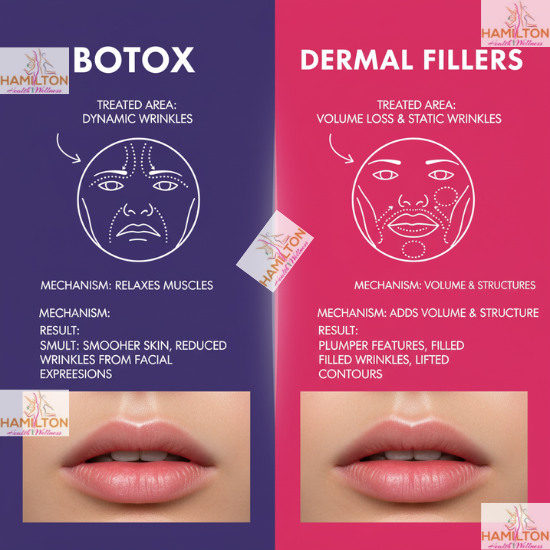
Botox vs Dermal Fillers: What Is the Difference?
| Botox | Dermal Fillers |
|---|---|
| Relaxes facial muscles | Restores lost volume |
| Best for dynamic wrinkles | Best for static wrinkles and contouring |
| Results develop within 3–14 days | Results are visible immediately |
| Lasts approximately 3–4 months | Lasts 6 months to 2 years depending on filler |
| Softens expression lines | Adds volume and facial definition |
Although both treatments reduce signs of aging, Botox addresses muscle activity while fillers replace volume lost during the aging process.
Dermal Fillers or Botox for Forehead: Which Is Better?
Many patients ask whether they should choose dermal fillers or Botox for forehead lines.
In most cases, Botox is the preferred treatment for horizontal forehead wrinkles because these lines develop from repeated muscle movement. By relaxing the forehead muscles, Botox softens existing lines and helps prevent deeper wrinkles from forming.
Dermal fillers may occasionally be used for deep static forehead lines that remain visible even when the face is at rest, but this treatment requires advanced expertise because the forehead contains important blood vessels.
Your provider may recommend Botox alone or a combination approach depending on your individual facial anatomy.
Botox vs Fillers Cost: Which Is More Affordable?
One of the most common questions patients ask is about the cost of Botox vs dermal fillers.
Botox is generally priced per unit, while dermal fillers are priced per syringe. Because Botox requires ongoing maintenance every three to four months, the long-term investment may be comparable to fillers despite a lower initial treatment cost.
The overall price depends on:
- Treatment area
- Number of Botox units required
- Number of filler syringes needed
- Provider experience
- Geographic location
A personalized consultation is the best way to receive an accurate treatment estimate.
Is Botox and Filler Bad for You?
Patients often wonder, “Is Botox and filler bad for you?”
When administered by qualified medical professionals using FDA-approved products, both Botox and dermal fillers have well-established safety records.
Complications are uncommon but can occur if treatments are performed by inexperienced injectors or if inappropriate products are used. Choosing an experienced provider significantly reduces potential risks and helps achieve natural-looking results.
Which Is Safer: Botox or Fillers?
Another common concern is, “Which is safer, Botox or fillers?”
Both treatments are considered safe when performed by trained healthcare professionals.
Botox has been used medically and cosmetically for decades with extensive safety data. Dermal fillers are also safe but carry a slightly higher risk of vascular complications if injected incorrectly because fillers physically occupy tissue space.
Neither treatment should be considered inherently safer than the other. Safety depends largely on patient selection, proper injection technique, and provider experience.
Side Effects of Botox and Fillers
Understanding the side effects of Botox and fillers helps patients make informed treatment decisions.
Common temporary side effects include:
- Mild swelling
- Redness
- Bruising
- Tenderness
- Minor discomfort at injection sites
Botox may occasionally cause temporary eyelid drooping or eyebrow asymmetry if the product spreads beyond the intended muscles.
Dermal fillers may rarely cause lumps, unevenness, or vascular complications requiring prompt treatment.
Most mild side effects resolve within several days.
Botox and Fillers Pros and Cons
Like all cosmetic procedures, both treatments have advantages and limitations.
Botox Pros
- Reduces dynamic wrinkles effectively
- Prevents deeper wrinkle formation
- Quick treatment with minimal downtime
- Natural-looking results when properly administered
Botox Cons
- Temporary results requiring maintenance
- Does not restore lost facial volume
- Results take several days to become visible
Dermal Fillers Pros
- Immediate improvement
- Restores facial volume
- Enhances facial contours
- Long-lasting results compared with Botox
Dermal Fillers Cons
- Higher upfront cost
- Temporary swelling or bruising
- Rare vascular complications if injected improperly
Your provider may recommend combining both treatments to achieve comprehensive facial rejuvenation.
How to Choose the Right Treatment
Choosing between Botox vs dermal fillers depends on your cosmetic concerns.
Botox is generally the preferred option for expression lines caused by muscle movement, while fillers are ideal for restoring facial volume and enhancing contours.
During your consultation, your provider will assess facial anatomy, muscle activity, skin quality, medical history, and treatment goals before recommending a personalized plan.
For many patients, combining Botox and fillers provides the most balanced and natural rejuvenation.
Conclusion
Although Botox vs dermal fillers are often grouped, they serve different purposes and complement one another exceptionally well. Botox relaxes muscles responsible for dynamic wrinkles, while fillers restore lost volume and improve facial contours.
Understanding the differences in cost, longevity, safety, and treatment goals allows patients to make informed decisions and achieve natural-looking, long-lasting results with the guidance of an experienced aesthetic provider.
Contact Hamilton Wellness for the treatment or consultation.